

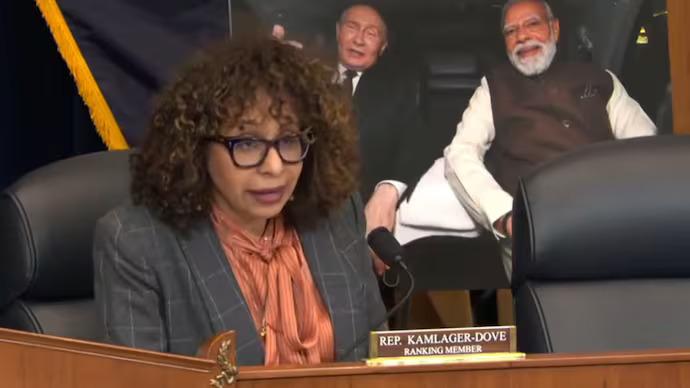
PM–Putin Car Selfie Sparks Debate in US Congress: Lawmaker Warns of Strained India–US Ties
A seemingly casual selfie of Prime Minister Narendra Modi and Russian President Vladimir Putin, taken during their drive from Delhi airport to the Prime Minister’s residence, has unexpectedly turned into a major flashpoint in the United States Congress. What was meant to be a gesture of friendship between the two leaders has now been highlighted by a US lawmaker as a warning sign of deteriorating India–US relations.
The image, displayed on a large poster in a Congressional hearing room, has amplified conversations about Washington’s foreign-policy approach toward New Delhi — and whether America’s pressure tactics are inadvertently pushing India closer to Russia.
🇮🇳🇷🇺 The Viral Car Ride That Started It All
During Vladimir Putin’s visit to India, PM Modi personally received him at Delhi’s Palam Airport. The two leaders then got into the same vehicle and travelled together — a rare, informal diplomatic gesture that instantly went viral worldwide.
Putin later said the car ride symbolised “genuine friendship.”
Indian officials described it as a sign of the deep trust and personal bond between the two leaders.
For the Indian public, the picture became a symbol of strong India–Russia ties, rooted in decades of cooperation in defence, energy, and space.
But in Washington, the same photo became a symbol of something else entirely.
🇺🇸 Photo Used as ‘Warning’ in US Congress
During a hearing on South and Central Asia, Democratic Congresswoman Sydney Kamlager-Dove displayed the enlarged image of Modi and Putin and told the committee that this photo captures the result of flawed US foreign policy.
She warned:
“This picture is worth a thousand words.
If we continue down this path, we risk losing India.”
According to her, America’s rising tariffs, sanctions threats, and coercive diplomacy under the current US administration are damaging trust between the two countries. She suggested that these policies could push India further into Russia’s orbit.
⚠️ “Losing India Would Be a Strategic Mistake”: US Lawmaker
The lawmaker argued that India is one of America’s most crucial partners in the Indo-Pacific region — essential for global stability, supply-chain diversification, and counter-balancing China. Any long-term tension, she warned, would:
weaken the US presence in Asia
damage defence cooperation
disrupt trade and technology partnerships
push India toward Russia and possibly China
She emphasised that policies like sanctions pressure over Russian oil, disagreements on defence purchases, and trade restrictions have already created friction and must be reviewed.
🌏 Why India–Russia Warmth Worries the West
From Washington’s perspective, the Modi–Putin car selfie is more than just a friendly gesture. It represents:
1. India’s refusal to isolate Russia
Despite Western pressure post-Ukraine conflict, India has maintained steady ties with Moscow, especially in:
oil imports
missile and defence systems
nuclear energy cooperation
space and satellite projects
2. India’s strategic autonomy
New Delhi does not take sides based on global pressure.
It prioritizes:
national interest
historical partnerships
regional security
energy security
3. A challenge to US global influence
As America tries to isolate Russia diplomatically, India’s warm relations with Moscow complicate the West’s geopolitical strategies.
🇮🇳 India’s View: “We Don’t Choose Sides — We Choose Interests”
Indian analysts dismissed the US concerns, arguing that:
India has always maintained independent foreign policy.
Relations with Russia date back over 50 years — long before the US considered India an ally.
India does not appreciate foreign lectures on its diplomatic choices.
For India, the Putin–Modi bonding is simply a continuation of a long, strategic partnership — not a rebuke to Washington.
🏛️ US Politics Behind the Photo Controversy
Observers also note that the photo’s use in Congress is partly influenced by:
internal US political rivalry
debates over President Trump’s foreign policy
concerns over losing global influence
anxiety about China’s rise and Russia’s resilience
The car selfie became an easy visual tool to criticize US strategy and highlight its diplomatic missteps.
🔮 What This Means for the Future
The episode raises important questions about the future of India–US relations:
1. More diplomatic friction likely
Trade disputes, technology restrictions, and defence expectations may create more tensions.
2. India will continue balancing between major powers
India will not abandon Russia to please the US — nor will it abandon the US to please Russia.
3. The world is moving toward multi-polar power politics
India has emerged as a major pole, engaging with all sides without aligning exclusively with any.
4. Expect more symbolic moments like this
As global geopolitics intensify, simple gestures such as car rides, handshakes, and selfies will continue to carry major political significance.
Conclusion
A single photograph of PM Modi and President Putin — friendly, informal, and symbolic — has sparked a major debate in Washington.
To some, it shows India’s increasing closeness to Russia.
To others, it reflects America’s diplomatic miscalculations.
But to India, it simply shows one message:
New Delhi will decide its alliances on its own terms — not under external pressure.
Leave a comment
Your email address will not be published. Required fields are marked *